
Misc
Understanding Dog Communication: Your Complete Guide to Reading Body Language & Behavior Signals

Written by Ashlie Adams, M.S. Psychology, DN-CET
Understanding dog communication is honestly one of the most important skills you can develop as a dog parent. Think about it—your dog is constantly “talking” to you through their body language, sounds, and facial expressions. But here’s the thing: most of us never learned how to speak “dog.”
After 20+ years working in Applied Behavior Analysis (first with kids, now with dogs—and honestly, there are SO many similarities), I’ve learned that the secret to preventing behavior problems and building an amazing bond with your dog comes down to one thing: actually understanding what they’re trying to tell you.
In this guide, I’m going to break down everything you need to know about reading your dog’s signals, spotting stress before it becomes a problem, and using this knowledge to create enrichment activities your dog will love.
Why Understanding Dog Communication Actually Matters

Your dog is communicating with you all day long—through how they hold their tail, where their ears are pointing, how tense their body is, and the sounds they make. When we miss these signals (or totally misread them), we can accidentally stress them out, miss chances to help them, or even end up in unsafe situations.
Here’s what happens when you get good at understanding dog communication:
- You catch stress early – Way before it turns into chewed furniture or snapping at visitors
- Your bond gets stronger – Your dog feels like you actually “get” them
- Behavior problems decrease – You’re addressing their needs before things go sideways
- Everyone stays safer – You can read situations with other dogs and people better
- Enrichment actually works – You can tell what your dog loves vs. what stresses them out
- Training goes smoother – You know when they’re ready to learn vs. when they’re overwhelmed
Bottom line: When you understand what your dog is saying, you become their best advocate and friend.
The Three Ways Dogs “Talk” to Us
Dogs communicate through three main channels, and they usually use all three at once to get their point across.
1. Body Language
This is your dog’s primary way of communicating. Dogs are amazing at reading body language—from other dogs AND from us—and they expect us to understand theirs too.
2. Sounds (Vocalizations)
Barking, whining, growling, howling, and even those dramatic sighs all mean something specific depending on what’s happening, how it sounds, and how long it lasts.
3. Facial Expressions
Here’s something cool: research shows that dogs actually developed facial expressions specifically to communicate with humans. They use their eyes, mouth, and even their “eyebrows” to show us how they’re feeling.
Let’s Decode Dog Body Language: What They’re Really Saying
Tail Talk
High, stiff tail:
- They’re alert, aroused, or feeling confident
- Could mean excitement OR potential aggression
- You’ve gotta look at their whole body to know which
Wagging tail (high and fast):
- High arousal—might be excited, but could also be overstimulated or frustrated
- Not always “happy”—context is everything
Relaxed, mid-level wag:
- This is the “I’m happy and friendly” wag
- Loose, sweeping motion = genuine happiness
Low or tucked tail:
- Fear, anxiety, or “please don’t hurt me”
- Your dog is uncomfortable and needs either space or reassurance
Slow, stiff wag:
- They’re unsure or cautiously checking things out
- Your dog is still deciding how they feel about the situation
💡 Real talk: A wagging tail doesn’t automatically mean a happy dog. You’ve got to look at how high it is, how fast it’s moving, and how stiff it looks along with everything else.
Ear Positions
Forward and alert:
- Focused attention and interest
- They’re engaged and ready to respond
Relaxed and neutral:
- Calm, comfortable vibes
- Your dog feels safe
Pinned back (flat against head):
- Fear, anxiety, or submission
- Can also mean “I’m not a threat, I promise”
One ear forward, one back:
- Split attention
- They’re trying to listen to two things at once
Eye Contact and Gaze
Soft eyes with a relaxed face:
- Trust and affection
- Your dog feels totally safe with you
Hard stare (direct, unblinking):
- This is a challenge or warning
- Can come right before aggressive behavior
- Never stare back—that just makes it worse
Whale eye (you can see the whites of their eyes):
- Stress, anxiety, or discomfort
- Your dog is worried about something
- Super common when they’re guarding something or feeling trapped
Avoiding eye contact:
- Calming signal—”I’m not a threat”
- Respectful way of acknowledging another dog’s space
- Can also mean they’re stressed or want to disengage
Squinting or slow blinking:
- Relaxation and contentment
- Trust signal (kind of like cats do)
Mouth and Lip Signals
Relaxed, slightly open mouth:
- Calm and comfortable
- That “smiling” look many dogs have when they’re happy
Lip licking (when they’re not eating):
- Stress signal or “please don’t be mad at me” gesture
- “I’m uncomfortable with what’s happening right now”
- You’ll see this a lot at the vet or when they’re being scolded
Yawning (when they’re not tired):
- Stress relief mechanism
- Calming signal to themselves or others
- Super common during training sessions or tense situations
Panting (when they’re not hot or exercising):
- Can mean stress or anxiety
- Check the context—is something stressing them out?
Showing teeth/snarling:
- Clear warning signal
- “Back off—I’m really uncomfortable”
- Respect this boundary immediately
Tight, closed mouth:
- Tension or stress
- Your dog is holding back or feeling uncertain
Body Posture
Play bow (front end down, butt up):
- Invitation to play
- “Everything I’m about to do is just for fun!”
- One of the clearest, most positive signals
Loose, wiggly body:
- Happiness and excitement
- Relaxed and comfortable
Stiff, rigid body:
- High arousal—could be fear or aggression
- Your dog is on high alert
Cowering or crouching:
- Fear or extreme submission
- Your dog needs reassurance and space
Leaning into you:
- Seeking comfort and security
- Can also be a subtle “you’re mine” claim
Turning away or moving slowly:
- Calming signal—trying to reduce tension
- “I’m not a threat, let’s chill out”
Raised hackles (that mohawk look):
- High arousal—can be fear, excitement, or aggression
- Not always aggressive—check other signals
Understanding Dog Sounds
Barking: It’s All About Context
Alert bark (sharp, repetitive):
- “Someone’s here!” or “I heard something!”
- Territorial awareness kicking in
Play bark (higher pitched, bouncy):
- Excitement and invitation to play
- Usually comes with a play bow
Demand bark (persistent, aimed at you):
- “I want something—pay attention to me!”
- Can become a problem if you keep giving in
Fear bark (intense, might include backing away):
- “I’m scared—stay away!”
- Your dog needs space and reassurance
Frustration bark (rapid, often with pacing):
- Barrier frustration or unmet needs
- Common in dogs who see other dogs through windows
Other Sounds
Whining:
- Seeking attention, expressing a need, or showing excitement
- Can mean pain—check what’s happening
- Sometimes an appeasement behavior
Growling:
- Warning signal—”I’m uncomfortable”
- NEVER punish growling—it’s super valuable communication
- If you punish the growl, you don’t fix the fear; you just remove their warning system
Howling:
- Communication over distance
- Response to certain sounds (sirens, music)
- Can mean separation distress
Sighing:
- Contentment and relaxation
- Your dog is settling in comfortably
Common Mistakes People Make Reading Dog Communication
Mistake #1: “My dog looks guilty”
What you see: Dog avoids eye contact, ears back, cowering after you find your chewed-up shoe.
What’s actually happening: Your dog is responding to YOUR body language and tone right now—not feeling “guilty” about the shoe from earlier. They’re showing appeasement signals because they can tell you’re upset.
The science bit: Dogs don’t experience guilt like humans do. They live in the moment and are reacting to how you’re acting right now.
Mistake #2: “A wagging tail means my dog is friendly”
What you see: Tail wagging, so you think it’s safe to approach.
What’s actually happening: Depends on how high the tail is, how fast it’s wagging, and how stiff their body is. A high, stiff, fast wag can mean overstimulation or potential aggression.
Better approach: Look at the whole dog—body tension, ear position, mouth, and overall vibe.
Mistake #3: “My dog is just being stubborn”
What you see: Dog won’t do a command they “know.”
What’s actually happening: Your dog might be stressed, distracted, in pain, or the environment is too stimulating. They’re not being defiant—they’re overwhelmed.
Better approach: Check the environment and your dog’s stress signals. Make it easier or move somewhere calmer.
Mistake #4: “My dog loves hugs”
What you see: Your dog tolerates hugs without moving away.
What’s actually happening: Most dogs find hugs stressful—it feels like restraint, not affection, in dog language. Look for whale eye, lip licking, pinned ears, or body stiffness.
Better approach: Show affection in ways dog likes—gentle petting, play, or just hanging out nearby.
Mistake #5: “Rolling over means submission”
What you see: Dog rolls onto their back.
What’s actually happening: Could be submission, but often it’s asking for belly rubs or a play behavior. Context and other signals tell you which.
Better approach: If the dog looks tense with a tucked tail and won’t look at you, it’s fear-based. If they’re wiggly with soft eyes, they want belly rubs.
How Understanding Dog Communication Makes Enrichment Actually Work
Here’s where this gets really cool: when you can read your dog’s signals, you can customize enrichment activities to match how they’re feeling and what they actually like.
I always tell my club members: “If your dog is frustrated, it is not enrichment.”
Enrichment should challenge your dog’s brain without stressing them out. When you can read their communication during activities, you can adjust things in real-time.
Reading Your Dog During Enrichment
Signs your dog is engaged and having fun:
- Loose, relaxed body
- Soft eyes with focused attention
- Tail in neutral or slightly raised with gentle movement
- They keep coming back for more
- Trying different approaches to solve the puzzle
- Occasional glances at you (checking in, not begging for help)
Signs your dog is frustrated or overwhelmed:
- Body stiffness or tension
- Whale eye or hard stare at the puzzle
- Excessive panting or lip licking
- Walking away over and over
- Getting aggressive with the toy (hard chewing, throwing it)
- Barking or whining at the puzzle
- Constantly looking to you for help
What to do: If you see stress signals, make it easier immediately. Hide fewer treats, make them more visible, or use better rewards. Success builds confidence; frustration makes them want to quit.
Enrichment Activities That Help You Practice Reading Your Dog
Interactive Puzzle Toys
Puzzle toys give mental stimulation while letting you practice reading your dog’s problem-solving style and stress signals.
How to use what you’re learning:
- Start with easy puzzles and watch how your dog approaches them
- Look for signs they’re engaged vs. frustrated
- Adjust difficulty based on their body language
- Celebrate their effort, not just getting it right
Good options to try:
- Snuffle mats for foraging instincts
- Treat-dispensing balls for active dogs
- Sliding puzzle boards for problem-solvers
- Frozen Kongs for long-lasting fun
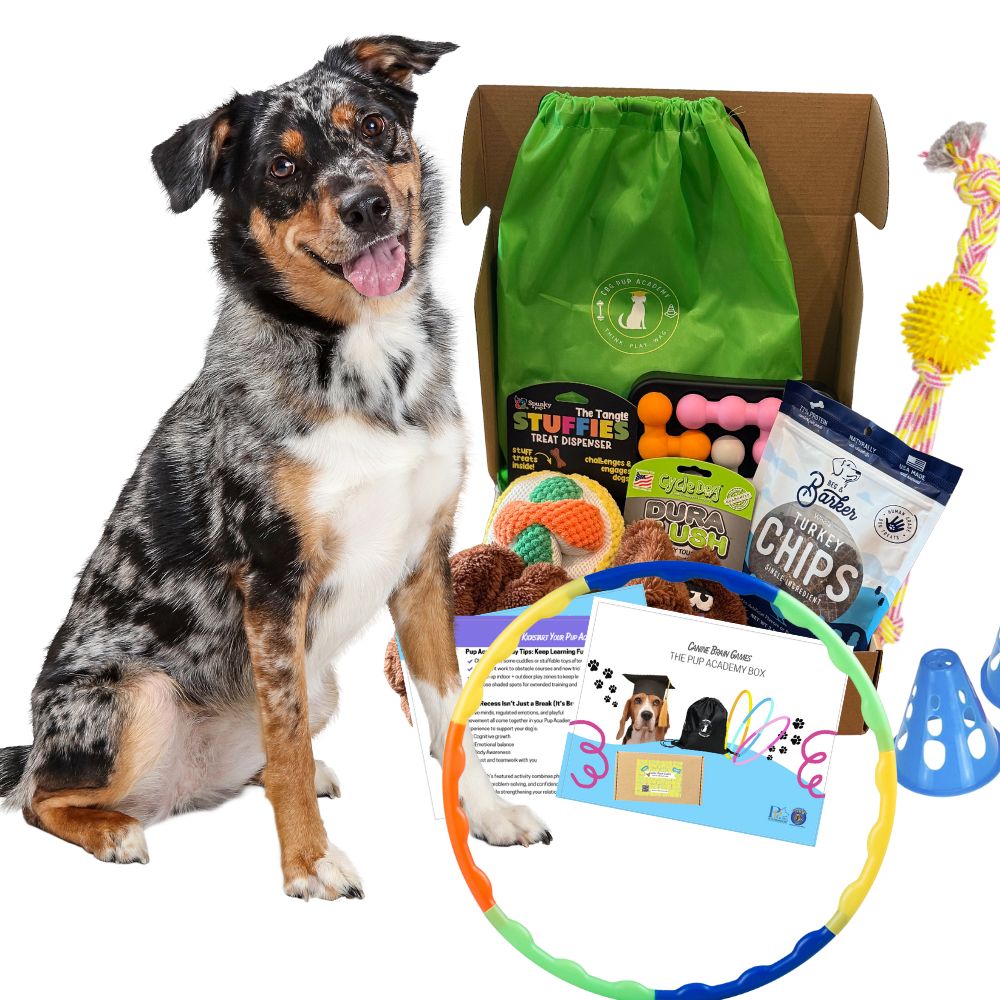
The Canine Brain Games box includes puzzles and toys matched to your dog’s play style (Chewer, Chaser, Cuddler, or Forager), so you don’t have to guess what they’ll like.
Training Sessions: Communication in Real Time
Training sessions are perfect for practicing understanding dog communication while building your bond.
How to train with communication in mind:
- Watch for stress signals—if you see them, make it easier
- Reward effort and engagement, not just perfect performance
- Keep sessions short (5-10 minutes max)
- End on a win to build confidence
- Use your dog’s communication to know when they need a break
Skills that help you both communicate better:
- Touch (nose to hand) – builds focus and connection
- Name recognition for toys – develops their vocabulary
- “Find it” games – taps into natural scent work abilities
- Impulse control exercises – teaches patience and self-regulation
Social Stuff: Reading the Room
Understanding dog communication is super important for safe, positive social experiences.
For social dogs:
- Watch for play signals (play bow, loose body, taking turns)
- Check for overstimulation (stiff body, intense focus, ignoring other dogs’ signals)
- Take breaks every 15-20 minutes
- Step in if play gets one-sided or tense
For reactive or anxious dogs: You can still give them social enrichment from a distance:
- Watch other dogs from far enough away that your dog stays calm
- Reward calm observation and checking in with you
- Gradually get closer over weeks/months as confidence builds
- Never force interaction—let your dog set the pace
Know your dog’s threshold: That’s the distance where your dog notices a trigger but stays calm. Work right at that edge for gradual improvement.
One of my dogs struggles around other animals, so we do “distance socialization” during car rides and walks where we can observe from far away. He gets social stimulation without getting overwhelmed.
Scent Work and Nose Games
Scent work naturally engages dogs while giving you chances to read their communication during focused activity.
Why scent work is great for practicing this:
- Dogs are in their element (using their nose)
- Lower stress than some other activities
- You can watch their “seeking” behavior and problem-solving style
- Builds confidence in anxious dogs
Easy scent games to start:
- Hide treats around a room while your dog waits
- Say “Find it!” and watch how they search
- Notice their body language when they’re “on the scent” vs. just searching randomly
- Celebrate every find enthusiastically
Fun fact: Dogs have over 300 million scent receptors compared to our measly 5-6 million. Using their nose gives them deep satisfaction and taps into their natural instincts.
Enrichment for All Dogs (Even Seniors and Dogs with Mobility Issues)
One of my senior dogs has mobility challenges, but that doesn’t stop us from doing daily enrichment. Understanding his communication helps me pick activities that work for him.
Low-impact enrichment ideas:
- Muffin tin puzzles with tennis balls or plastic cones covering treats
- Snuffle mats for stationary foraging
- Lick mats with frozen treats (calming and long-lasting)
- Scent games they can do sitting or lying down
- Gentle training sessions for mental engagement
Reading senior dog communication:
- Watch for pain signs (not wanting to move, tense face, avoiding certain positions)
- Respect lower energy—shorter sessions work better
- Celebrate small wins—their brain might not work as fast, so be patient
- Keep their success rate around 80%
Regular mental stimulation can actually slow cognitive decline in senior dogs, which makes enrichment even more important as they age.
Practical Tips for Getting Better at Dog Communication
1. Watch and Learn Every Day
Pay attention to your dog’s normal behavior when they’re relaxed and happy. This helps you notice when something’s off.
Try keeping a communication journal:
- Note your dog’s typical tail position when relaxed
- Watch ear positions in different situations
- Write down what triggers stress signals
- Track which enrichment activities they love
2. Respect Calming Signals
When your dog shows calming signals (lip licking, yawning, turning away, moving slowly), they’re trying to de-escalate tension.
How to respond:
- Give them space
- Reduce pressure or intensity
- Change the environment or activity
- Never punish these signals—they’re healthy communication
3. Figure Out Your Dog’s Stress Threshold
Every dog has a threshold—the point where they go from calm to stressed.
How to find it:
- Watch for the first subtle stress signal (usually lip licking or whale eye)
- Note what triggered it—distance, intensity, or how long it lasted
- Work just below that threshold to build confidence
- Gradually expand their comfort zone over time
4. Use Positive Reinforcement
Reward your dog for communicating clearly with you.
Examples:
- Your dog moves away from something uncomfortable → Praise them for speaking up
- Your dog shows calming signals around a trigger → Reward that emotional control
- Your dog checks in with you during enrichment → Celebrate that connection
5. Be Patient and Keep at It
Getting good at understanding dog communication takes time. You’ll mess up—we all do. That’s part of learning.
Remember:
- Every dog is different with their own communication style
- Context always matters—the same signal can mean different things
- When in doubt, give your dog space and ease up
- Trust builds over time through consistent, respectful interaction
6. Make Enrichment a Regular Thing
Build cognitive enrichment into your dog’s daily routine to keep their brain active and give yourself chances to practice reading their communication.
Daily enrichment ideas:
- Morning: Puzzle toy or scatter feeding for breakfast
- Midday: Quick training session or nose game
- Evening: Interactive toy or calm enrichment (lick mat, frozen Kong)
The Canine Brain Games box brings fresh activities every two months, giving you ongoing variety and mental stimulation matched to your dog’s play style.
What Happens When You Combine Communication Skills and Enrichment
When you put understanding dog communication together with regular cognitive enrichment, magic happens:
✅ Stronger bond – Your dog feels understood and safe with you
✅ Less anxiety – You catch and address stress before it gets bad
✅ Better behavior – You’re meeting needs before they turn into problems
✅ More confidence – Your dog learns they can communicate and you’ll listen
✅ Better mental health – The right challenges keep their brain healthy
✅ Better quality of life – Your dog becomes more adaptable and resilient
✅ Safer interactions – You can read situations and step in before problems start
Your Questions About Understanding Dog Communication (Answered!)
How do I know if my dog is stressed?
Common stress signals: lip licking, yawning (when not tired), whale eye (showing whites), pinned-back ears, panting (when not hot), tucked tail, tense body, and avoiding eye contact. Context matters—look for several signals together, not just one.
What does it mean when my dog yawns during training?
Yawning during training usually means stress or needing a break. It’s a calming signal they use to self-soothe. What to do: Make it easier, take a quick break, or end on a win.
Can dogs understand human body language?
Yes! Research shows dogs are really good at reading human body language, facial expressions, and even following where we look. They’ve evolved with us for thousands of years and developed this skill. That’s why your body language matters so much.
Why does my dog avoid eye contact?
Avoiding eye contact is often a calming signal or sign of respect in dog language. Direct eye contact can feel confrontational or threatening to them. If your dog avoids eye contact, they might be showing respect, feeling uncomfortable, or trying to de-escalate.
What is “whale eye” and why does it matter?
Whale eye is when you can see the whites of your dog’s eyes, usually because they’re looking at something while keeping their head turned away. It means stress, anxiety, or discomfort. Common times: guarding something, feeling cornered, or uncomfortable with handling.
How can I tell if my dog is playing or fighting with another dog?
Healthy play looks like: Play bows, taking turns (chasing then being chased), loose wiggly bodies, open mouths, taking breaks, and both dogs coming back for more.
Warning signs: One dog always on top/chasing, stiff bodies, intense focus without breaks, pinned ears, closed mouths, one dog trying to get away, or yelping without stopping.
Should I punish my dog for growling?
Never punish growling. Growling is valuable communication—your dog is saying “I’m uncomfortable, please stop.” If you punish the growl, you don’t fix the fear; you just remove their warning system. This can create a dog who “bites without warning” because we taught them not to communicate.
Start Understanding Your Dog Today
Understanding dog communication isn’t just about preventing problems—it’s about building a relationship based on mutual respect, trust, and real connection.
When you learn to read your dog’s body language, sounds, and facial expressions, you become their advocate in a human world that doesn’t always make sense to them.
Start today by:
✅ Watching your dog’s normal behavior when they’re relaxed
✅ Looking for stress signals during daily stuff
✅ Respecting their communication by adjusting what you’re doing
✅ Adding enrichment that matches how they’re feeling
✅ Celebrating when they communicate with you
Your dog has been trying to talk to you all along. Now it’s time to really listen.
Ready to Level Up Your Dog’s Enrichment?
Join the Canine Brain Games Community
Want science-based enrichment while practicing your communication skills? Our bi-monthly boxes include:
Puzzle toys – Different difficulty levels matched to your dog’s play style
Scent work activities – Snuffle mats, foraging toys, and nose games
Training guides – Step-by-step instructions that respect your dog’s communication
Customized for play style – Pick Chewer, Chaser, Cuddler, or Forager
Enrichment Barkive access – 100+ digital resources and expert guidance
Every box is designed by yours truly—a certified canine enrichment technician with a Master’s in Psychology and 20+ years of experience in Applied Behavior Analysis (working with both kids and dogs).
Subscribe Now – $45.99 every two months
About the Author
Ashlie Adams holds a Master’s degree in Psychology with a focus in Applied Behavior Analysis and is a certified Canine Enrichment Technician (DN-CET) and certified in Dog Emotion & Cognition. With over 20 years of hands-on experience (including years as a preschool teacher and working with elementary and middle school students in mental and behavioral health) and having fostered more than 30 behaviorally complex dogs, Ashlie founded Canine Brain Games in Charlotte, NC to make science-based enrichment accessible to every dog parent.
Learn more: caninebraingames.dog