training & brain games (non-food or mix)

In this video, you’ll learn how to teach your dog the Touch cue. This is a simple behavior where your dog uses their nose to target your hand. It’s one of the most versatile skills in enrichment and training. It’s great for building focus. It encourages engagement and lays the groundwork for more advanced behaviors.

Builds focus and encourages active engagement with you

Strengthens body and spatial awareness

Introduces the concept of intentional object interaction

Opens the door to more advanced behaviors like visual targeting, mobility games, and complex tricks

Serves as a stepping stone to activities like Criss Cross, where your dog learns paw targeting

Creates a reliable foundation for redirecting attention and guiding movement
  • Your hand (or a flat object like a lid or mat for advanced variations)
  • High-value treats
  • A clicker or verbal marker (optional but helpful)
  1. Start Simple: Present your flat, open palm a few inches from your dog’s nose.
  2. Mark the Behavior: The moment your dog’s nose makes contact with your hand, mark it with a “yes” or click.
  3. Reward Immediately: Follow up with a treat to reinforce the behavior.
  4. Add Distance & Duration: Gradually move your hand to different positions—higher, lower, to the side—to build flexibility and confidence.
  5. Introduce the Cue: Once your dog reliably touches your hand, add the verbal cue “Touch” just before presenting your palm.
  6. Level Up: Swap your hand for a flat object like a lid, sticky note, or mat to transition toward paw targeting or other advanced skills.
  • Keep sessions short and upbeat—aim for 5–10 repetitions at a time
  • If your dog seems confused, go back a step and make it easier
  • Lightly scent your hand with a treat to encourage that first nose touch
  • Practice in different locations to build reliability and generalization
  • Use Touch as a tool for redirecting attention during distractions or stressful moments

What You’ll Do

Reinforce calm choices and allow your dog to decompress.

Quick How-To

  1. Sit together in a low-distraction space

  2. Reward calm behaviors

  3. Let stillness happen naturally

Pro Tip

Calm doesn’t need to look “perfect” to count.

Remember

Regulation is a skill. Learn how to introduce your dog to a mat with the video below. This is a great skill to teach when working on impulse control. Video created by DogNostics Education.

Which Hand Game: A Simple & Fun Brain Game for Your Dog!
Looking for an easy and engaging way to challenge your dog’s mind? The Which Hand Game is a fantastic scent-based activity that enhances your pup’s problem-solving skills while strengthening your bond. Plus, all you need is your hands and a couple of treats or a favorite toy!

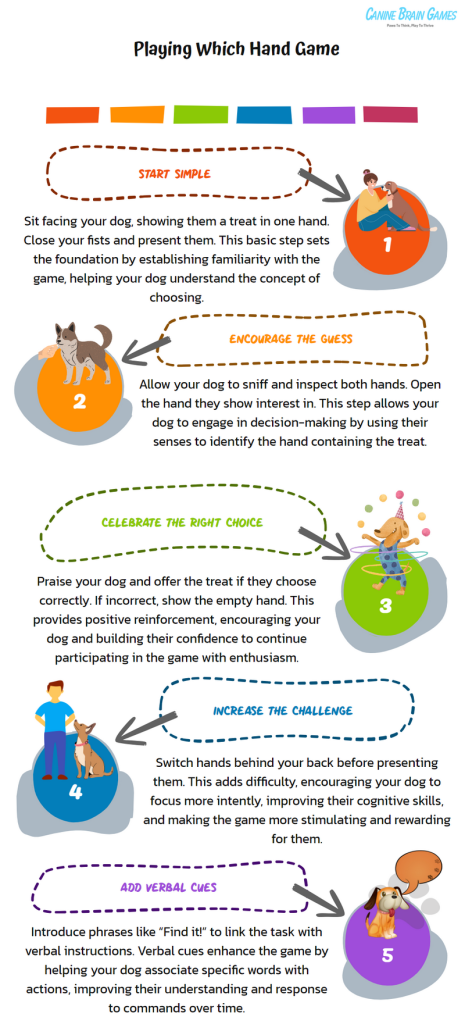
Infographic illustrating how to play the Which Hand Game with a dog, featuring step-by-step instructions and playful graphics of a person and a dog engaging in the game.

Boosts Problem-Solving Skills: Your dog learns to use their nose and decision-making skills to choose the correct hand.
Enhances Scent Work Abilities: Dogs experience the world through their noses—this game taps into their natural sniffing instincts.
Encourages Focus & Patience: Helps improve impulse control and attention to detail.
Strengthens Your Bond: Interactive play builds trust and deepens your connection.
Great for Any Dog: Whether you have a puppy, senior, or high-energy pup, this game provides mental stimulation without needing much space or equipment.

What You’ll Need:
✔️ Small treats or a favorite toy (if your dog isn’t food-motivated).
✔️ Your hands!


Step-by-Step Directions:
1️⃣ Start Simple: Sit in front of your dog and show them the treat in one hand. Then, close your fists and hold them out in front of your dog.
2️⃣ Encourage the Guess: Let your dog sniff and investigate both hands. When they show interest (by sniffing, nudging, or pawing) at a hand, open it.
3️⃣ Celebrate the Right Choice: If your dog picks the correct hand, praise them and give them the treat! If they guess wrong, simply reveal the empty hand and let them try again.
4️⃣ Increase the Challenge: Once your dog understands the game, make it harder by switching hands behind your back before offering them a choice.
5️⃣ Add Verbal Cues: You can introduce words like “Find it!” or “Which hand?” to help your dog associate the game with the task.

✅ Use a High-Value Reward: If your dog struggles to focus, try using a stronger-smelling treat or their favorite toy.
✅ Keep Sessions Short & Fun: 5-10 minutes is enough to keep engagement high without frustration.
✅ Encourage Gentle Play: If your dog paws too hard at your hands, reinforce nose touches only before revealing the prize.
✅ Turn It Into a Challenge: Time your dog to see how fast they can find the correct hand, or increase the number of rounds before rewarding.

Looking for a simple and engaging way to entertain your pup? With just a few treats and some creativity, you can turn it into a fun and challenging treat-dispensing toy that encourages problem-solving and play.

This activity taps into your dog’s natural foraging instincts and keeps them engaged as they work to release the hidden treats!

✔️ Enhances Body Awareness – Walking on uneven surfaces improves balance, coordination, and confidence.
✔️ Stimulates the Senses – Different textures underfoot engage curiosity and sensory processing.
✔️ Encourages Natural Foraging – Scattering treats taps into your dog’s instinct to sniff, search, and problem-solve.
✔️ Provides Mental & Physical Engagement – A well-rounded activity that combines gentle physical movement with cognitive stimulation.
✔️ Customizable for All Dogs – Adjust the difficulty by changing textures, heights, and treat placements to match your pup’s comfort level.

✔️ An empty, clean plastic bottle (labels and cap removed)
✔️ Your dog’s favorite treats or kibble
✔️ Optional: Scissors (to modify difficulty by adjusting hole size)

  1. Grab an empty, clean plastic bottle (remove the cap and any labels).
  2. Place a few of your dog’s favorite treats or pieces of kibble inside the bottle.
  3. Show your dog how the treats come out when the bottle is moved around.
  4. Let your pup nudge, paw, or roll the bottle to get the treats out.


  • Always supervise your dog while they play with the bottle to ensure they don’t chew or eat the plastic.
  • For more of a challenge, use a bottle with a smaller opening or add larger treats that are harder to get out.
  • If your dog is new to this activity, start with an easy setup by leaving the cap off and using small treats.

Tag us with your creative plastic bottle treat toys by using #CanineBrainGames. We’d love to see your pup having a blast!

This site uses cookies to offer you a better browsing experience. By browsing this website, you agree to our use of cookies.